EN | 中文

💻 MTCode Studio

A free VS Code-based editor that adds multi-workspace tabs and integrated project configuration, build, and debugging for C/C++ and Python projects.
No telemetry.

Free forever

What Is MTCode Studio?

MTCode Studio is a customized distribution built on the VS Code open-source codebase. It keeps the familiar VS Code editing experience while adding multi-workspace tabs and integrated project configuration, build, and debugging for C/C++ and Python projects — especially useful for developers who like VS Code but want a more Visual Studio-like project workflow.

MTCode Studio is a standalone editor, independent from MTCode DirectLink. It is free to use with no usage limits.

🗂️

Multi-workspace tabs

Organize work into named workspaces and switch between them from a tab bar inside one window.

⚙️

Integrated Project Workflow

Configure C/C++ build settings or Python run tasks through dialogs. Build and Debugging are seamlessly integrated.

🎁

Free forever

No paid tier, subscription, or usage limit. Independent from MTCode DirectLink.

What Makes It Different from Standard VS Code?

Better Project Organization

  • Workspace tabs — keep multiple named workspaces open and switch between them instantly. Each workspace can contain multiple project folders.
  • Project dropdown — choose the active project folder within the current workspace.
  • Language detection — automatically detect whether the selected project is C/C++, Python, or TypeScript/JavaScript, with manual override when needed.

Integrated Configuration, Build, and Debugging

  • C/C++ configuration — configure compiler, target type, source files, include paths, libraries, macros, and build options through a guided dialog.
  • Python task configuration — define reusable tasks for training, inference, evaluation, or general scripts, including script paths, arguments, interpreter selection, and dataset paths.
  • Generated project files — create CMakeLists.txt and .vscode/tasks.json for C/C++ builds, and .vscode/launch.json for running and debugging C/C++ and Python projects.
  • Familiar execution workflow — use the integrated Build menu for C/C++ projects, and the Run/Debug menu for C/C++ or Python tasks.
MTCode Studio main interface

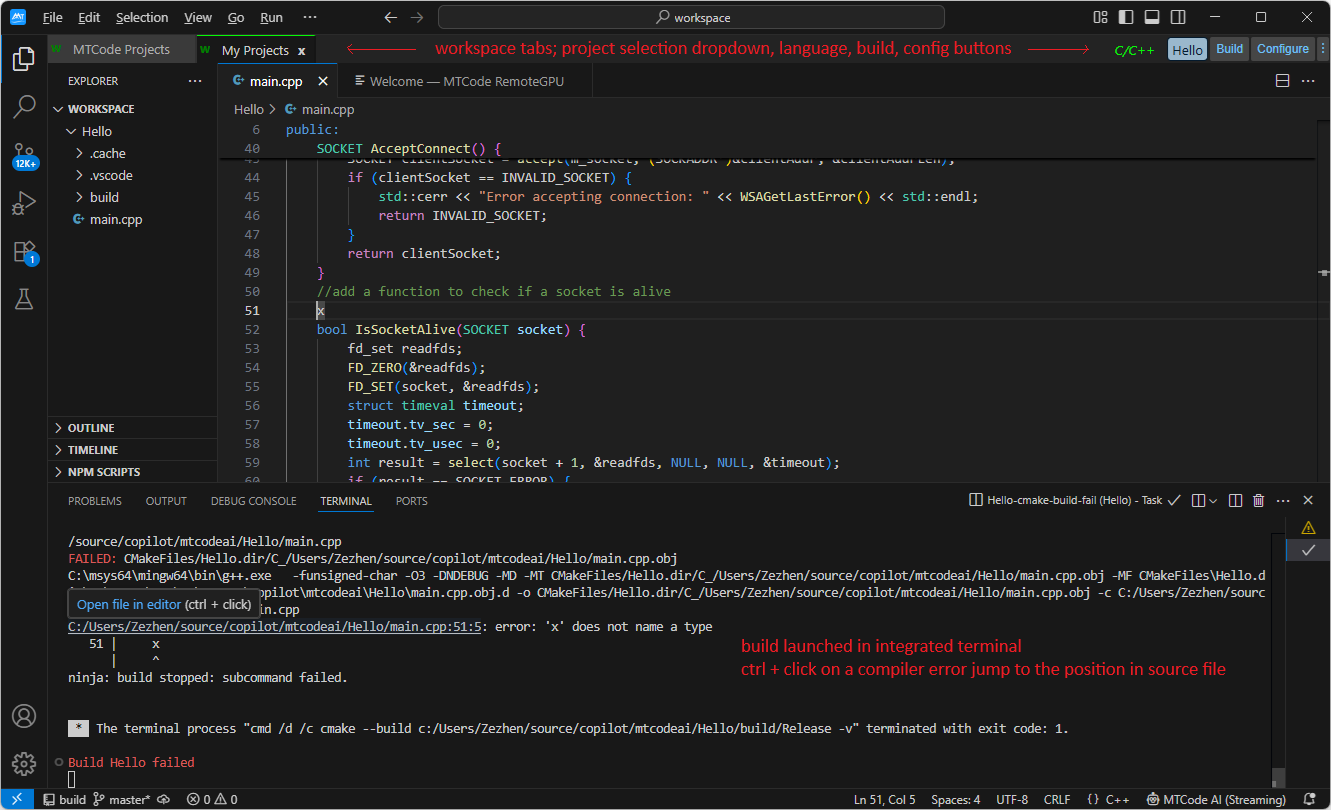
MTCode Studio — switch between workspaces via tabs, select active project from the dropdown, then configure, build, run, or debug without leaving the editor.

Watch MTCode Studio in Action

A walkthrough of multi-workspace management, project configuration, build/debug workflow, and the optional AI Phoenix coding assistant. Click to play.

Multi-Workspace Tabs

MTCode Studio adds a workspace tab bar to help you keep separate projects, clients, courses, experiments, or repositories organized without opening a separate editor window for each context.

Workspace Management

  • Create a new workspace as a tab.
  • Rename tabs to match projects, courses, clients, or experiments.
  • Close or reorder workspaces when your context changes.

Workspace Memory

  • Add multiple project folders to each workspace.
  • Keep each workspace’s folders, open editors, and settings separate.
  • Switch context without reloading the whole application.

Project Toolbar

The project toolbar sits on the workspace tab bar. It gives you quick access to the active project folder, language Id, configuration dialog, build commands, and Python task selection.

📁

Project Folder Dropdown

Lists folders in the active workspace so you can choose which project to configure, build, run, or debug.

🌐

Language Selector

Shows the detected language of the active project and lets you override it when automatic detection is not what you want.

⚙️

Configure Button

Opens the project-specific configuration dialog for C/C++ build settings or Python task settings.

C/C++ Project Configuration

For C/C++ projects, MTCode Studio provides a guided configuration dialog that can generate CMake files, build tasks, and debug configurations. After setup, you can use the Build command in the toolbar to compile your project, and use the standard Run/Debug workflow to launch or debug it.

The experience is designed to feel closer to Visual Studio-style project configuration and build management, while keeping the familiar VS Code editing environment.

Build Settings

  • Auto-detected or manually added MSVC, GCC, and Clang compilers.
  • Build target type: console application, GUI application, static library, or shared library.
  • C/C++ standard, optimization level, runtime library, output path, and target name.
  • Project dependencies: when multiple projects are in the same workspace, you can define which projects depend on others. Integrated Build and Debug commands then build them in the correct order automatically.

Sources, Paths, and Linking

  • Editable source file list, include paths, and library paths.
  • Separate Debug and Release settings for libraries, macros, compiler options, and linker options.
  • Optional post-build commands for copy steps, tests, packaging, deployment scripts, or other custom actions.

Python Project Configuration

MTCode Studio automatically detects available Python interpreters. For each Python project, you can select an interpreter, add another interpreter or environment, and define multiple named tasks.

This is especially useful for machine-learning workflows, where training, inference, evaluation, preprocessing, and experiments may each use different scripts, arguments, or datasets.

Task Setup

  • Create named tasks such as training, inference, evaluation, preprocessing, or experiments.
  • Select the Python script, command-line arguments, interpreter, and dataset folders for each task.
  • All configured tasks are saved in .vscode/launch.json.
  • Use the toolbar task dropdown to choose which task to run or debug.

Dataset Paths

  • Define up to three dataset paths per task. Each path can point to a folder containing the data files required by that task.
  • Reference dataset paths in script arguments using ${env:dataset-1}, ${env:dataset-2}, and ${env:dataset-3}.
  • Reuse the same task configuration locally or with MTCode RemoteGPU when running the project on a remote GPU server.
Optional MTCode Extensions

MTCode Studio includes MTCode RemoteGPU and MTCode AI Phoenix as preinstalled extensions for convenience. The editor itself is standalone and does not depend on MTCode DirectLink. If you do not need these extensions, you can disable or remove them just like any other VS Code extension.

🚀

MTCode RemoteGPU

Connect to authorized MTCode GPU Server instances from the editor, upload Python projects, run jobs on remote GPUs, and stream results back to your workspace.

🔥

MTCode AI Phoenix

Experiment with a self-hosted AI coding assistant connected through MTCode DirectLink. Useful for learning, coursework, small projects, and local-model workflows.

🧩

Still VS Code Compatible

Use your existing extensions, themes, settings, and development habits. MTCode Studio keeps the familiar VS Code foundation while adding its own workflow features.

⬇ free download
× ×